There’s something pretty irresistible about walking into a new construction home in Amarillo.
Everything is clean. Everything is shiny. Nobody has ever cooked spaghetti in the kitchen, hung a questionable light fixture in the dining room or tried to repair something with duct tape and optimism.
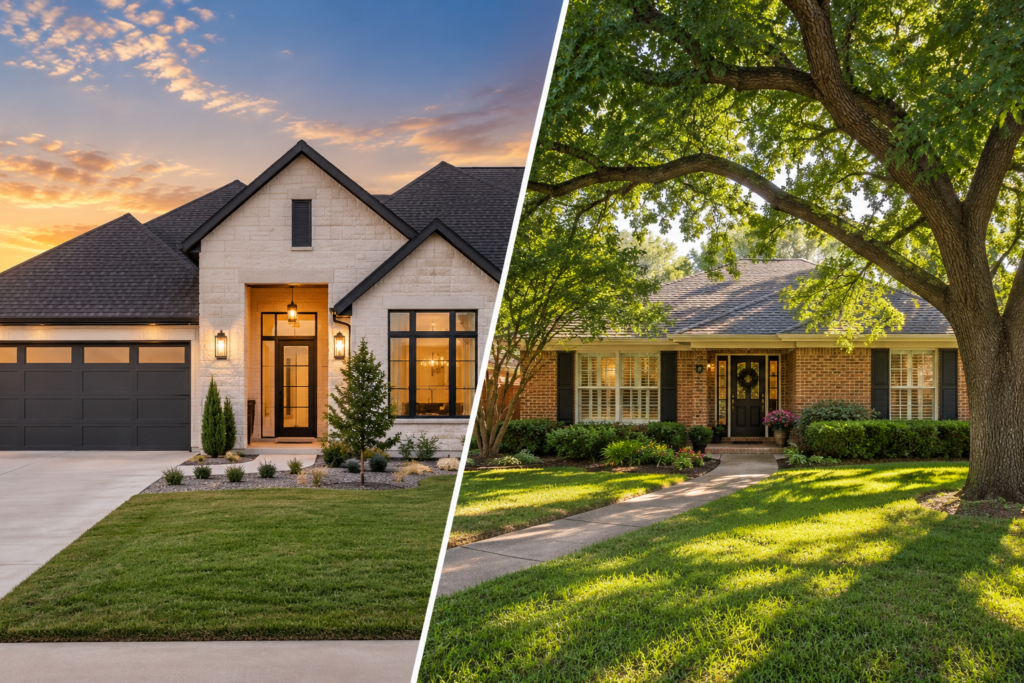
But then you walk into an older home with big rooms, mature trees, an established neighborhood and considerably more square footage for your money.
Suddenly, the decision gets a little harder.
So when buyers ask me whether they should buy new construction in Amarillo or an older home in Amarillo or Canyon, my answer is usually:
Let’s look at what you’re really getting with each one.
The Appeal of New Construction in Amarillo
One of the biggest advantages of new construction is pretty obvious: everything is new.
You generally have newer systems, newer materials and fewer immediate maintenance concerns. New homes may also come with builder and manufacturer warranties, although coverage varies considerably by builder, product and property.
Before buying, I want my clients to understand exactly what is covered, for how long and what they need to do if there is a warranty issue.
But there are tradeoffs.
When you’re comparing new construction in Amarillo with an older home, it’s important to look beyond the purchase price.
Newer homes often have a higher price per square foot than older homes. Depending on the development, you may also find smaller rooms, smaller lots and landscaping that has a long way to go before it feels established.
And around here, a mature tree is practically a luxury item.
Plant one now and someday you’ll have a beautiful shade tree.
Someday.
The New-House Expenses Buyers Sometimes Forget
Here’s something I want buyers to understand:
New house does not necessarily mean no additional expenses.
Depending on what is included with the property, you may still need to budget for things like:
- Blinds or window coverings
- Landscaping
- Irrigation
- Fencing
- Appliances
- Additional storage
- Other finishing touches that make the house actually function like your home
If you’re buying or building on one of the larger lots outside the city, the list can grow.
Some of the newer developments around Amarillo and Canyon offer acre-plus lots, and buyers love the idea of having that much space.
I understand why.
But before you fall in love with an acre, let’s talk about what it takes to maintain an acre.
How much is already fenced? Will you want additional fencing? What about irrigation? Landscaping? How are you going to mow it?
And if the property isn’t served by municipal trash collection, how will you handle garbage service? Are you hiring a private trash company? Using rollaway carts? Do you need some other solution?
None of those things mean you shouldn’t buy the house.
They just need to be part of the real cost of owning it.
What About an Older Home?
Older homes can offer some wonderful advantages.
You can often get more square footage for your money. Rooms may be larger. Lots may be more established. And you may get something that takes decades to create:
mature landscaping.
But an updated kitchen and pretty flooring don’t tell us everything we need to know about an older house.
That’s when we start looking a little deeper.
What I Look at When Showing an Older Home
First, I’m paying attention to the roof.
We get plenty of hail in the Texas Panhandle, so roof age, condition, prior damage and insurability matter. We’ll want the appropriate professionals—and your insurance company when necessary—to help us understand what we’re dealing with before you buy.
I’m also looking at the windows.
Have they been replaced? How old are they? Are there visible signs of deterioration, moisture intrusion or other problems that deserve a closer look?
Then there’s the foundation.
I’m not diagnosing foundation problems during a showing—that’s a job for qualified professionals—but I am paying attention.
Cracking around doors or windows, visible movement, unusual floor changes or stair-step cracking in brick or mortar may give us a reason to investigate further.
A crack doesn’t automatically mean we have a major foundation problem.
It means we ask another question.
Plumbing and Sewer Lines Matter, Too
With an older home, plumbing deserves attention.
Depending on the property’s age and history, I may recommend having the sewer line scoped with a camera in addition to the regular home inspection.
We’re looking for things such as damaged or deteriorated piping, cracks, obstructions and root intrusion.
Those aren’t particularly exciting things to spend money investigating.
Neither is replacing a sewer line.
I’ll take the camera inspection.
For a property with a private well or septic system, those systems require their own due diligence. I want to understand their condition, maintenance history and whether additional inspections or servicing are appropriate before closing.
Don’t Forget Electrical and Drainage
Electrical systems are another consideration with older homes.
A house was generally constructed according to the requirements in effect at the time it was built, and older homes may not have every safety feature or electrical configuration you would expect in a newer house.
That’s one of the reasons a good inspection matters.
I also pay attention to drainage.
Where does the water go when it rains?
Ideally, water moves away from the foundation toward appropriate drainage rather than collecting against the house.
You don’t need to become a roofing contractor, electrician, plumber and structural engineer before buying an older home.
That’s why we hire good professionals.
My job is to help you know when we need to ask another question.
Before We Compare the Houses, Let’s Research Their History
This is a step I think buyers sometimes overlook.
Before I tell you which house I prefer, I want to know more about who built them.
Who built the new house?
Is it part of a large development or a custom build?
What is the builder’s reputation? What do homeowners say about their experience? If there are older phases or completed homes from the same builder, how are those properties holding up?
And I want to research the older house, too.
If we can determine who originally built it, that’s useful information. I also want to know what has happened to the house since then.
Has it been remodeled?
Was there a major addition?
Was plumbing or electrical work performed?
Was the kitchen substantially reconfigured?
For significant renovations, we may be able to research available permit history and other records. The City of Amarillo requires permits for many building, remodeling, electrical, plumbing and mechanical projects, and the City of Canyon similarly requires permits for many types of construction, alteration and repair work. Requirements and available records vary by project, jurisdiction and date, so permit history is one piece of our due diligence—not the entire story.
A beautiful remodel tells me what a house looks like today.
Its history can help us understand how it got there.
So Which Would I Choose: New or Old?
Now we get to the tricky part.
Let’s say we’ve done our homework.
We’ve researched the builders. We’ve looked at the inspections. We’ve considered maintenance, repairs and additional costs. Both homes are financially comfortable for you, and neither one has given us a reason to walk away.
Now I think feelings get to have a seat at the table.
Where will you put your Christmas tree?
Can you picture yourself sitting on the front porch or back porch with a cup of coffee?
Can you see your family making memories in this living room?
Can you imagine preparing holiday meals in this kitchen?
When friends or family come to visit, is there enough room to entertain? Where will everyone sleep?
Does the drive to work, school and the places you regularly go make sense for your everyday life?
Look around the neighborhood. Do you like how the homes and properties are maintained? Can you picture yourself being part of it?
And then there’s the question I think matters most:
Can You See Your Story Being Written Here?
Does this house feel like it’s part of your family’s next chapter?
Because eventually, we’re not choosing between new construction and an older home anymore.
We’re choosing home.
And once you know which one feels like home, I think you’ve probably found your answer.
Thinking About Buying in Amarillo or Canyon?
I’m DeeDee Bennett, a REALTOR® with The Homestead Property Group, and I’ve spent nearly a decade helping buyers and sellers navigate real estate in the Texas Panhandle.
Whether you’re considering new construction, an established neighborhood, an older home with character or a little land outside town, I’d be happy to help you understand the tradeoffs and ask the questions that matter before you make your decision.
Because buying a house isn’t just about where you’re going to live.
It’s about what happens there next.
Every Home Tells a Story — Let me help you write your family’s next chapter.